
 Branches & agencies



Who’s teaching Britain about money?
To better understand the financial education experiences of younger adults in the UK, Hinckley & Rugby Building Society commissioned OnePoll to survey 2,000 UK adults aged 18 to 35.

Young adults have access to more financial information than ever before. From parents and teachers to social media, search engines and AI, there is no shortage of places to learn about managing money. But where are they actually turning for financial guidance, and how confident do they feel making financial decisions?
The research explores what people remember learning about money at school, who has had the biggest influence on their financial knowledge, where they now turn to with financial questions, and the growing role of social media and artificial intelligence (AI).
The findings reveal a generation piecing together its financial education from a wide range of sources. Parents remain the biggest influence overall, but among the youngest adults, platforms such as TikTok and YouTube compete with and sometimes overtake the classroom.
At the same time, almost one in five 18- to 35-year-olds have turned to AI with a financial question in the past year, while gaps in financial understanding have contributed to some young adults losing money, taking on borrowing they did not fully understand or delaying important financial decisions.
Key findings at a glance
- 4.9% of 18 to 35-year-olds say school or college taught them the most about managing money, compared with 30.8% who credit a parent or family member.
- 13.5% of 18 to 20-year-olds say TikTok taught them the most about managing money, compared with 8.0% who say school or college.
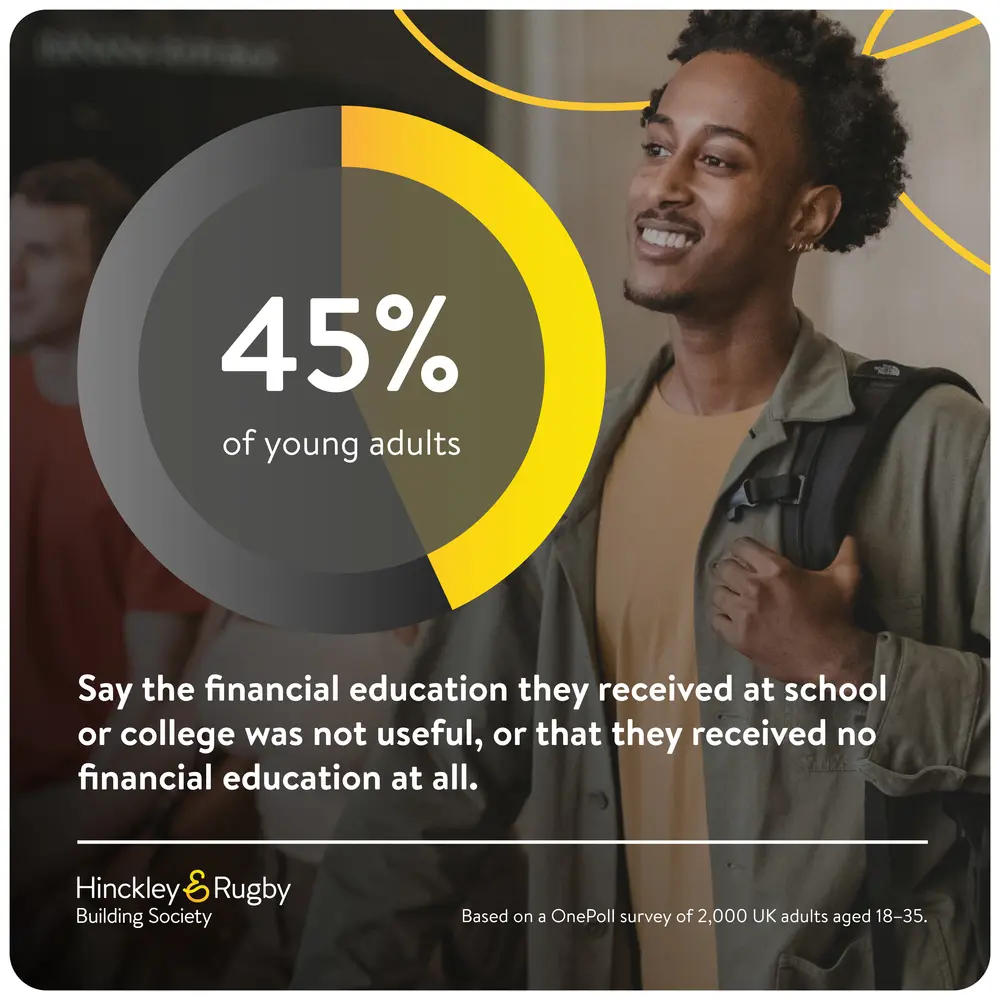
- 15.3% say they received no financial education at school or college, while a further 29.7% say the education they received was not useful.
- 18.2% have turned to an AI platform or chatbot with a financial question in the past 12 months.
- 15.8% have turned to a bank or building society with a financial question, compared with 18.2% who have turned to AI.
- 22.2% have used AI to help create a budget, while 19.9% have used it to set a savings goal and 18.6% to compare savings accounts or other financial products.
- 14.2% rarely or never check financial information found through social media, YouTube, search engines or AI against another source.
- 15.9% say they have lost money after following poor or misleading information because they did not understand enough about managing money at the time.
- 28.7% have felt anxious or overwhelmed about making a financial decision because of a lack of financial understanding.
- 26.1% say clearer information about savings accounts would help them feel more confident managing their money.
For many young adults, financial education did not start in the classroom
Financial education at school appears to have left a mixed impression among today’s 18 to 35-year-olds.
Overall, 51.8% describe the financial education they received at school or college as useful. This includes 26.1% who say it prepared them well for managing money as an adult and 25.7% who say it covered some practical topics.
However, 29.7% say their financial education was not useful, including 21.6% who say it did not prepare them for managing money as an adult.
A further 15.3% say they did not receive any financial education at school or college at all.
There is also an age difference. Some 10.5% of 18- to 20-year-olds say they received no financial education, rising to 18.3% among 31- to 35-year-olds. This could suggest that financial education has become more visible for younger generations, although substantial gaps remain.
But practical subjects that people encounter throughout adult life were less commonly recalled. Just:
- 27.7% were taught about savings accounts and interest.
- 20.3% were taught about creating and managing a budget.
- 19.3% were taught about tax and National Insurance.
- 18.2% were taught about credit cards.
- 17.0% were taught about financial scams and fraud.
- 14.8% were taught about borrowing and credit.
- 14.3% were taught about mortgages and buying a home.
- 14.3% were taught about debt and repayments.
- 14.2% were taught about pensions and retirement.
- 13.6% were taught about understanding a payslip.
Parents are Britain’s biggest financial teachers

When asked who or what taught them the most about managing their money, the answer is clear: parents and family.
Almost a third (30.8%) of 18 to 35-year-olds say a parent or family member was their biggest source of financial education.
That’s more than six times the proportion who selected school or college, at just 4.9%.
Family influence extends across individual areas of financial knowledge too.
Among respondents answering these questions, 36.0% say a parent or family member taught them the most about saving, while 35.3% say the same for budgeting.
Parents are also the leading source for borrowing and credit, at 21.8%, and pensions and retirement, at 18.2%.
The findings show just how much financial knowledge continues to be passed down through families rather than coming exclusively from formal education or financial institutions.
Other sources include:
- 8.4% Financial advisers
- 7.6% Friends or partners
- 6.8% Search engines or financial websites
- 6.1% YouTube
- 5.6% TikTok
- 4.9% School or college
- 4.6% Other social media
- 4.4% Banks or building societies
- 4.0% Employers or workplaces
- 2.7% AI platforms or chatbots
TikTok is overtaking school as a money teacher for the youngest adults
Across all 18 to 35-year-olds, 5.6% say TikTok taught them the most about managing their money, already slightly higher than the 4.9% who chose school or college.
But the difference becomes much more pronounced among 18- to 20-year-olds. In this group, 13.5% say TikTok has taught them the most about managing money, compared with 8.0% who credit school or college.
The accessibility of this information can be valuable, but unlike formal financial guidance, the quality and accuracy of content available online can vary significantly. Understanding who produced information, why it was published and whether claims can be verified against a reliable source is increasingly important.
YouTube also plays an important role. Across all respondents, 6.1% say YouTube taught them the most about managing their money, again higher than the proportion choosing school or college.
Social platforms therefore appear to have become part of the financial education landscape, particularly for younger adults.

TikTok’s influence declines considerably with age:
- 13.5% 18–20-year-olds
- 7.8% 21–24-year-olds
- 5.2% 25–30-year-olds
- 2.6% 31–35-year-olds
When young adults have a money question, family and Google still come first
Financial education does not end when people leave school. The study also asked where young adults turned to when they had a question about money during the past 12 months.
Parents and family remain the most popular source, selected by 34.3%.
Search engines are close behind at 27.7%, followed by friends or partners at 26.9%.
The full picture highlights the range of sources shaping financial decisions today:
- 34.3% Parent or family member
- 27.7% Search engine
- 26.9% Friend or partner
- 19.0% Financial adviser
- 18.2% AI platform or chatbot
- 15.8% Bank or building society
- 14.7% Financial comparison website
- 14.2% YouTube
- 12.2% TikTok
- 10.3% Other social media
- 9.0% Employer or workplace
- 8.1% Charity or free money-guidance service
- 6.6% Podcasts
Almost one in five young adults are now asking AI about money

One of the clearest changes in how younger adults access financial information is the emergence of AI.
Almost one in five (18.2%) 18- to 35-year-olds say they have turned to an AI platform or chatbot with a financial question during the past 12 months.
That makes AI a more commonly used source for financial questions than banks or building societies (15.8%), financial comparison websites (14.7%), YouTube (14.2%) or TikTok (12.2%).
And people aren’t only using AI to understand unfamiliar terminology.
The findings highlight the growing role AI is playing in helping some young adults understand and manage their finances. From creating budgets and setting savings goals to learning about investing and comparing financial products, AI is being used for a wide range of financial tasks.
While AI can make complex subjects easier to understand, responses can be inaccurate, incomplete or unsuitable for an individual’s circumstances. The quality and relevance of the information provided can also depend on the questions asked and the information shared with the AI. Important financial information should therefore be checked against reliable sources before acting on it.
When asked what they had used an AI platform or chatbot to help with, respondents selected:
- 22.2% Creating a budget
- 22.1% Understanding a financial term
- 20.4% Learning about investing
- 19.9% Setting a savings goal
- 18.6% Comparing savings accounts or financial products
- 17.8% Working out how much they can afford to spend
- 16.8% Understanding borrowing, credit or debt
- 16.8% Deciding whether to make a purchase
- 15.1% Learning about pensions
- 14.6% Preparing questions to ask a bank or financial professional
Not everyone is checking the financial information they find online
With more financial information coming from search engines, social media, YouTube and AI, the ability to assess whether information is reliable becomes increasingly important.
Encouragingly, 34.7% of respondents say they always check financial information they find through these sources against another reliable source, while 30.5% say they sometimes do.
However, 9.6% rarely check, while 4.7% never do.
Combined, that means 14.2% of young adults rarely or never verify online financial information against another source.
The behaviour is more common among the youngest adults surveyed. Among 18 to 20-year-olds, 18.6% rarely or never check, rising to 20.2% among 21 to 24-year-olds. This compares with 14.6% of 25 to 30-year-olds and 10.4% of 31 to 35-year-olds.
The findings suggest there may be a generational shift in how financial information is consumed and assessed, with younger adults appearing less likely to verify information they find online than their older peers

Gaps in financial understanding are having real-world consequences
A lack of financial knowledge isn’t simply about not knowing a financial term or being unsure how a particular product works.
The findings show that it can affect both financial confidence and financial outcomes.
When asked whether they had experienced certain situations because they did not understand enough about managing money at the time, 28.7% said they had felt anxious or overwhelmed about making a financial decision.
More than a quarter (26.6%) have struggled to stick to a budget, while 23.6% have needed to ask family or friends for financial help.
- 19.1% Paid more interest or charges than expected
- 17.8% Missed or made a late payment
- 16.3% Used credit for everyday costs
- 16.1% Put off opening a savings account
- 15.9% Lost money after following poor or misleading information
- 15.6% Taken out borrowing without fully understanding the repayments
- 15.0% Chosen a financial product that wasn’t right for them
- 10.9% Put off starting a pension
One particularly concerning finding is that almost one in six young adults (15.9%) say they have lost money after following poor or misleading information because they did not understand enough about managing money at the time.
Men were more likely than women to report this experience, at 19.7% compared with 14.1%.
The findings demonstrate why financial literacy is about more than simply understanding financial terminology. Confidence and knowledge can affect the everyday decisions people make about spending, borrowing, saving and planning for the future.
A lack of understanding can also stop people from saving
The research points to a direct relationship between financial confidence and saving behaviour.
Around one in six (16.1%) respondents say they have put off opening a savings account because they did not understand enough about managing money at the time.
Among 21- to 24-year-olds this rises to 17.9%.
These findings suggest that a lack of confidence or understanding can become a barrier to getting started with saving. Understanding how different savings accounts work, setting an achievable goal and building a regular savings habit can all help people take their first steps.
But if uncertainty around financial products creates a barrier to getting started, clearer information has an important role to play.
Young adults want clearer, more practical financial information

When asked what would make them feel more confident managing their money, the most popular answer was clearer information about savings accounts, selected by 26.1%.
Closely behind were tools or calculators showing how much to save (25.6%) and help creating a realistic budget (25.6%).
The findings suggest that confidence comes from practical, accessible information rather than more complex information. Young adults are looking for straightforward guidance that helps them make everyday financial decisions, from choosing a savings account and setting achievable goals, to budgeting and planning ahead.
There is also demand for both digital and human support. More than one in five would value online support from a bank or building society, while a similar proportion would value being able to speak with someone face-to-face.
Young adults also want:
- 24.5% Independent financial education online
- 24.2% Simple explanations of borrowing and credit
- 24.2% Help setting a savings goal
- 22.9% More information about pensions
- 22.3% Online support from a bank or building society
- 21.3% The ability to speak to someone face-to-face
- 20.7% Regular reminders or savings prompts
- 19.6% Financial education through an employer
What does this mean for financial education?
The way younger adults learn about money is changing.
Parents remain the single biggest influence, but they now sit within a much wider ecosystem of financial information that includes schools, banks and building societies, financial advisers, search engines, comparison websites, social media creators and AI
For the youngest adults in particular, TikTok and YouTube have become notable sources of financial education. At the same time, almost one in five 18 to 35-year-olds have turned to AI with a financial question during the past year.
Having more ways to access financial information can make learning about money easier. But access alone doesn’t guarantee understanding.
The findings show that gaps in financial knowledge can have consequences, from feeling anxious about financial decisions and struggling with budgeting to paying unexpected charges, delaying saving and, in some cases, losing money after following poor information.
For young adults navigating an increasingly complicated financial information landscape, knowing which sources to trust is therefore becoming an important financial skill in its own right.
Banks and building societies have an important role to play in helping people build that confidence. This includes providing clear, practical information that is easy to understand and apply to everyday financial decisions, helping customers make sense of the information they encounter elsewhere, and offering access to human support when reassurance or a more personal conversation is needed.
As the number of information sources continues to grow, trusted organisations can play an increasingly valuable role in helping people separate reliable information from opinion, speculation and misinformation.
For savers, particularly those starting out, the goal doesn’t need to be knowing everything about money. Building financial confidence can begin with smaller steps: understanding where your money goes, setting an achievable savings goal, learning how different savings accounts work and checking important financial information against trusted sources before making a decision.